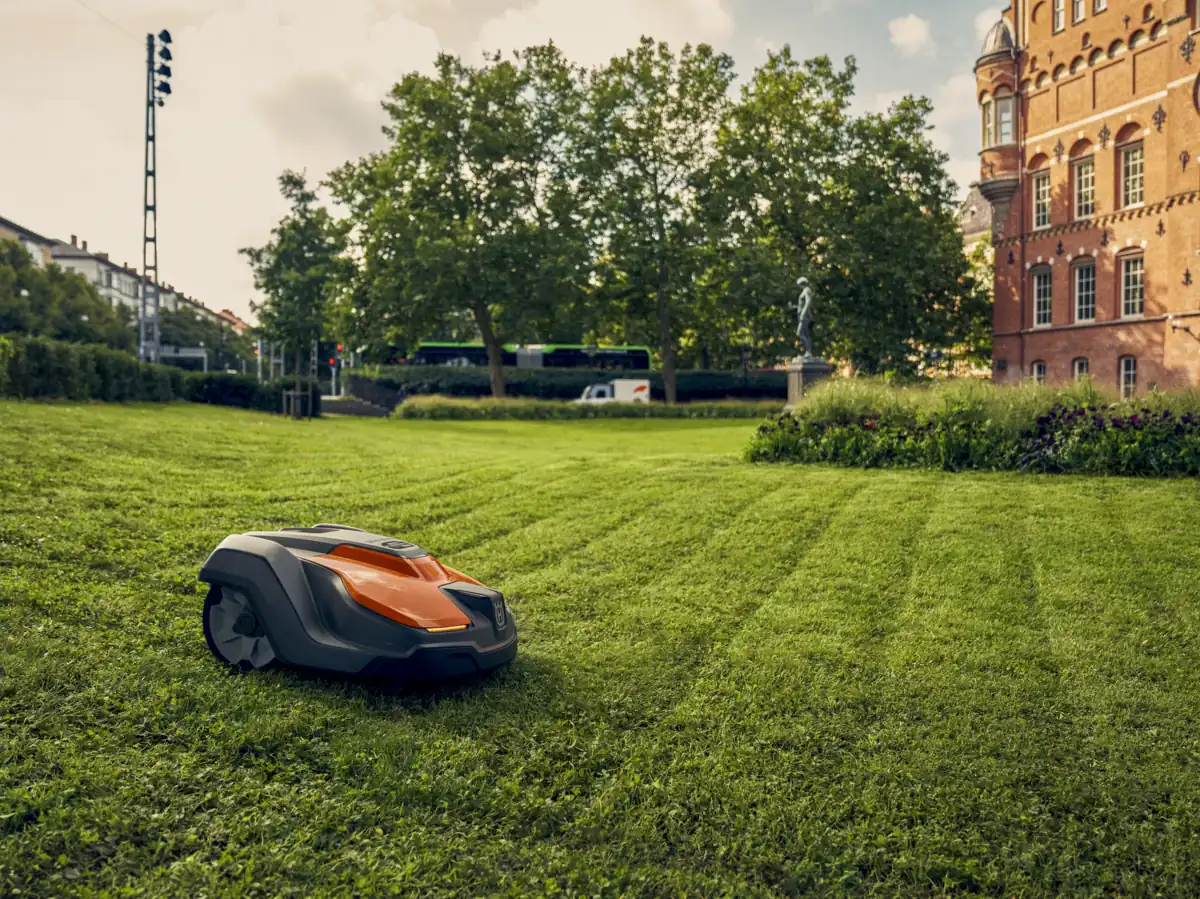
Grounds that are cut every day, not every Thursday
HOA common ground, apartment complexes, schools, business parks, churches and county green space — mowed continuously and quietly by machines that don't arrive on a trailer.
A crew cuts your grounds once a week. A robot cuts them every day, at the same height, for the same money over time.
That's the change worth understanding. It isn't that mowing gets cheaper — though on most sites it does eventually. It's that the grounds stop having a good day and a bad day. No shaggy Wednesday, no scalped Thursday, no rain week where nobody came. And no crew, trailer or two-stroke engine on site during business hours.
Properties where grass is somebody's problem
If you hold a mowing contract, manage grounds staff, or answer to a board about how the place looks, this is aimed at you.
Common ground
Entrances, medians, amenity lawns and the strips nobody agrees about. Consistent appearance, and a line item that stops rising every renewal.
Apartment complexes
Grounds that look cut on the day a prospective tenant tours, not just on Fridays. And no crew blocking the parking court at 8am.
Schools & campuses
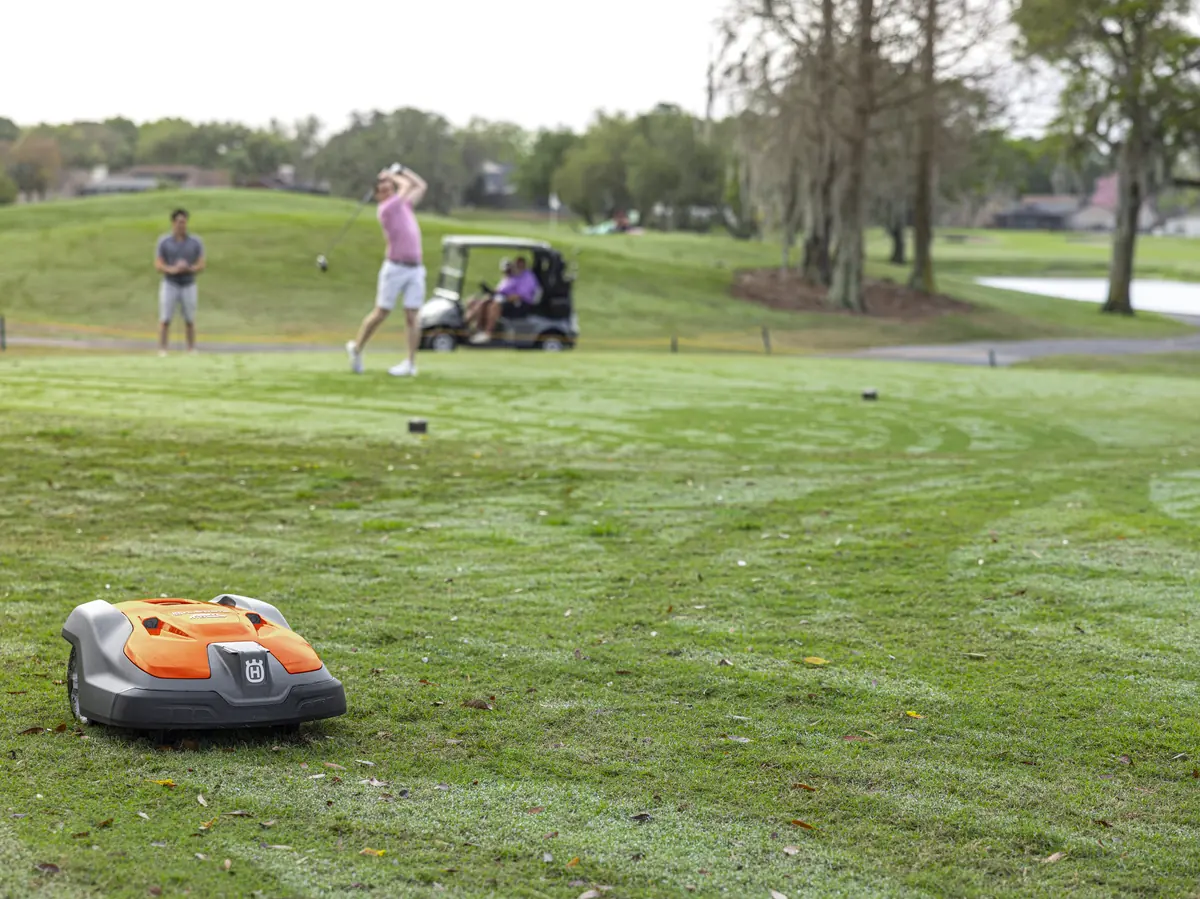
Mowing during school hours without engine noise through classroom windows, and without machinery moving where children walk.
Business & office parks
Frontage that's presentable every day of the week. Quiet enough to run past ground-floor offices and clinics mid-morning.
Churches & cemeteries
Grounds kept without a crew present during services, and without the cost of a contractor visit for a property used two days a week.
Parks & municipal
County and city green space, sports fields and civic frontage. We're a registered vendor and can respond to formal solicitations.
Landscape contractors
Add robotic mowing to what you offer without carrying the dealer relationship. We supply, install and support; the client stays yours.
Fields & recreation
Daily cutting is the agronomic standard for playing surfaces, and it's what these machines are built to do. Ask about the Sports 24 schedule.
Put it against what you pay now
Enter your own figures. We're not going to tell you what your contract costs or invent a saving — this does arithmetic on numbers you supply, using our real installed equipment prices.
Read this honestly. Simple payback compares equipment cost to the mowing portion of your spend. It ignores what the machines cost to run — electricity, blades every two to three months, and occasional service — and it assumes robotic mowing replaces the mowing element entirely. It also ignores the residual value of the equipment, which you own rather than rent. The real number comes out of a site assessment, not a web page.
What it doesn't replace
A robot mows. It does not do groundskeeping.
Anyone who tells you a mowing contract disappears is selling you something. Here is what still needs doing after the machines are in:
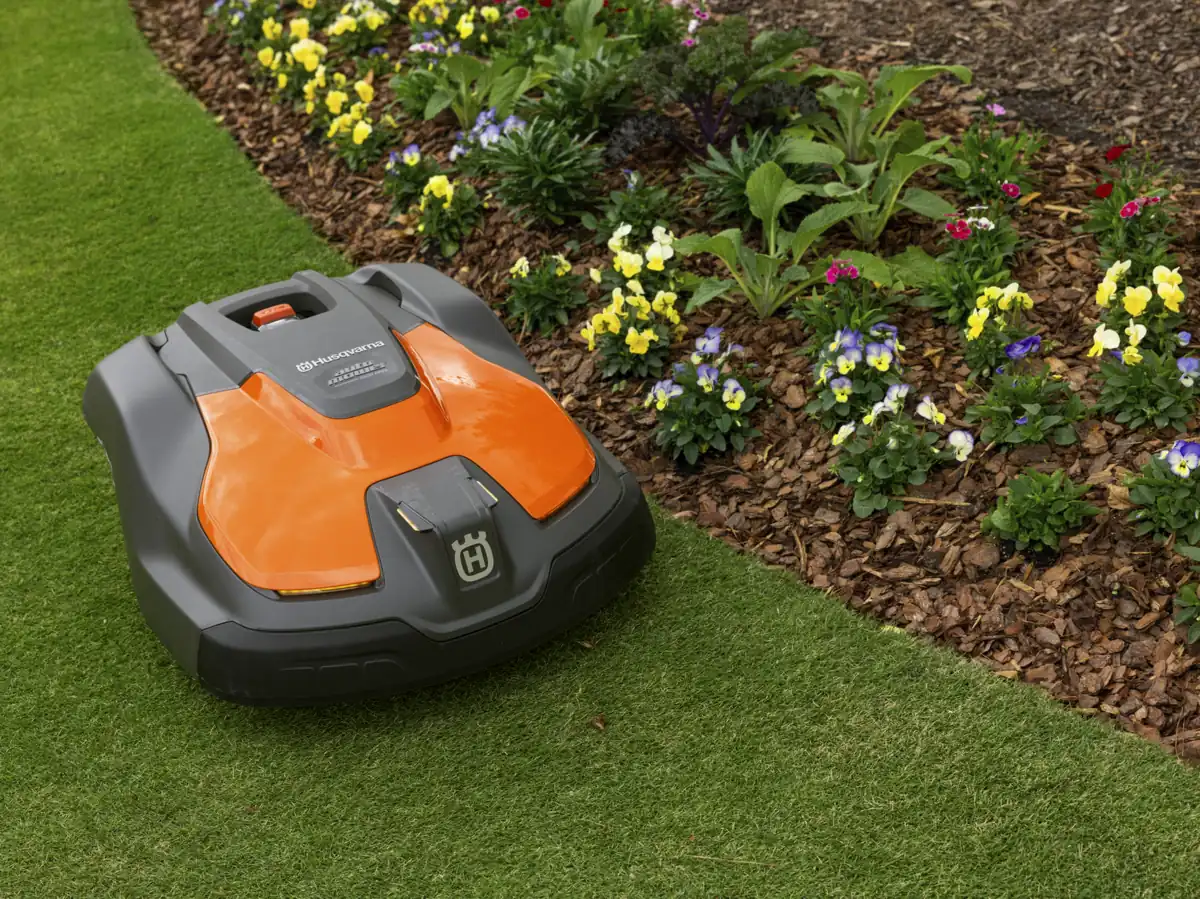
- Edging and string trimming. Against walls, kerbs, posts and beds. The mower gets close but not to a finished edge.
- Blowing and clean-up. Paths, car parks and entrances.
- Beds, shrubs, irrigation and trees. Entirely untouched by this.
- Steep banks and awkward pockets. Anything over 45%, or too narrow to enter, still needs a person.
What usually happens is that the contract shrinks and changes shape rather than ending — fewer visits, focused on the work a machine can't do. Several of our commercial clients kept their landscaper and simply stopped paying them to cut grass.
If your grounds crew owns the mowers, there's a second saving worth counting. Every service interval on a commercial mower — oil, filters, belts, spindles, blade sharpening — is scheduled by engine hour, and so is its useful life. Take the mowing hours off your machines and the servicing stretches, the fuel drops, and the next replacement gets pushed further out. On a site with its own equipment that is often the larger number, and it never appears in a mowing quote.
You'll know where every machine is
Professional machines report to Husqvarna Fleet Services — position, status, hours, faults and cutting history for every unit on the site, from a phone or a desk.
- See at a glance which machines are working and which want attention
- Change schedules and cutting heights remotely, across the whole fleet
- GPS tracking, geofencing, alarms and PIN protection on every unit
- Fault alerts reach us as well as you, so problems get chased rather than noticed
You choose who drives it. We manage the fleet for you on a service agreement, or we train your grounds staff and stay on call. Warranty work happens on site either way.

From first walk to running fleet
Nothing is owed until step three, and most sites start smaller than they finish.
Site assessment
We walk the grounds with you, measure the mowable area, identify zones, check satellite sky view across the site and find where docks and the reference station can go. We'll also put honest numbers against your current contract — including the parts a machine can't replace.
Coverage plan and written quote
How many machines, where they live, what schedule holds the turf at the height you want, and what it costs installed. Fixed price, in writing, before anything is ordered.
Start with one zone
On a large site we'd usually rather put one machine on one area first than sell you six. You get a season of evidence to take to a board or a budget holder, and we get a reference on your ground rather than someone else's.
Installation and commissioning
Docks sited, power supplies connected to your existing outlets, RS5 mounted for clear sky view, zones and schedules built, cutting heights set for your turf, first cuts supervised. We're not electricians — any new outlets need to be in before we arrive, and we'll flag that at the assessment.
Service agreement or staff training
Blades, firmware, seasonal adjustments and warranty work on a schedule we keep, or training so your crew handles the routine and calls us for the rest.
The objections, answered
Won't somebody just steal it?
It's the first question on every public site, and it's fair. Every machine has GPS tracking, geofencing, an audible alarm and PIN protection — it stops working the moment it leaves its zone and is useless to whoever took it. They're also cellular-connected, so you can see where one has gone.
Realistically: they're low, dark, quiet and mostly working at hours nobody is around. Theft happens, rarely, and it's an insurance conversation rather than a reason not to proceed. We'll talk through what other sites do.
Is it safe with the public walking across the grounds?
The blades are small pivoting razors set well inside the body and they stop when the machine is lifted or tipped. The professional machines also carry object detection, so they steer around obstacles rather than nudging them. They travel at walking pace and they're working when the site is quietest.
For schools specifically, the usual arrangement is scheduling that keeps machines off areas during recess and dismissal — which the app handles zone by zone.
What happens when it rains? This is Florida.
They keep working. That's part of the point — a robot doesn't lose a week to weather and then arrive to cut six inches of growth. Cutting a small amount daily through the wet season is considerably better for the turf than one heavy cut afterwards.
Will it damage our St. Augustine?
Not at the right height, which is why we only carry high-cut machines. University of Florida guidance puts standard St. Augustine at 3.5 to 4 inches; most robotic mowers stop at 2.4 and will scalp it. Ours reach 3.6 inches on the professional line and a full 4 on the residential machines. UF research also found daily light trimming produced denser St. Augustine rather than thinner.
What do we do with our current landscaper?
Usually keep them, on a smaller scope. Edging, blowing, beds, trees and irrigation all still need a person, and most of our commercial clients simply stopped paying a crew to cut grass. If your contractor would rather supply the machines themselves, send them to us — we work with landscape companies on exactly that basis.
Who fixes it when it breaks?
We do, on your site. We're the authorized Husqvarna dealer, so warranty work goes through us rather than through a shipping label and a queue. Parts are on our shelf in Tampa, not on order from a warehouse.
We're a public body. Can you work with our procurement process?
Yes. We can respond to formal solicitations, provide W-9, certificate of insurance and references, and quote to a specification. We're veteran-owned, which may matter for your set-aside requirements. If you're inside a cooperative purchasing agreement, tell us which and we'll work out how to be reachable through it.
Twenty minutes away, and answering the phone
You can buy robotic mowers online. What you can't buy online is somebody who surveyed your ground, knows where every dock and boundary sits, and can be there this week.
- Authorized Husqvarna Automower® dealer — sales, parts, warranty service
- Veteran and family owned, working out of Westchase since 2020
- Service and warranty work performed on your site
- Parts held locally rather than ordered in
- 5.0 on Google, and we'll give you references on comparable properties
Book a site assessment
We'll walk your grounds, measure what's actually mowable, bring a machine so you can watch it work, and give you a written coverage plan with a fixed price — plus an honest comparison against what you're paying now, including the work a machine won't do. No charge, anywhere within 60 miles of Tampa.